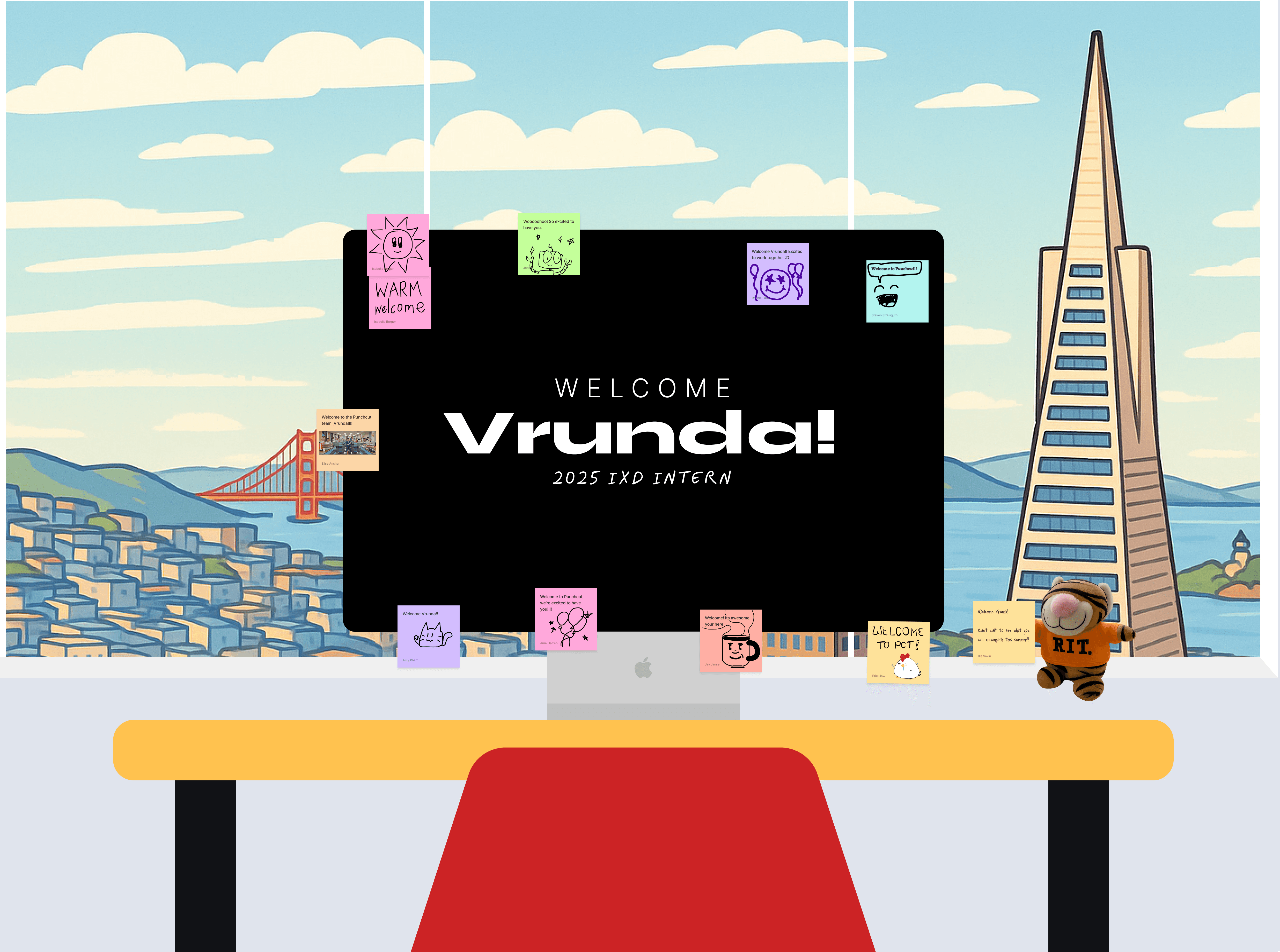
Punchcut - My Experience & Learnings
A flyby of my work from client projects to internal research and design
I'm currently working as an UX Designer at Punchcut, an agency focused on future-forward design for a range of clients. Over the course of time, I've collaborated with designers, researchers, engineers, and product managers to complete 5 projects across tech, streaming, and finance industries. This is an overview of my work at Punchcut.
Project Archetypes
3 client projects, 3 industries, 3 completely different design challenges.
Tech platform
Building a native application from 0-to-1 meant translating high-level business goals into concrete user flows and interaction patterns.
Streaming Service
Integrating a multi-domain product suite into the "living room" required solving for remote constraints to ensure the storytelling remained cohesive across the platform.
Financial Platform
Mapping permission systems via service blueprints was key to designing interfaces that made a dense enterprise tool feel approachable.
All project work is under NDA.
If you're interested in learning more, please reach out to me.
Learnings
Key insights from working across teams, industries, and unfamiliar problem spaces.
Tailoring the narrative
Each audience needs a different story. It is essential to adapt the presentation approach to the audience, ensuring stakeholders see the vision while engineers understand the logic .
Accepting ambiguity
Real-world briefs rarely have all the answers. The ability to drive momentum with imperfect information is often more valuable than waiting for certainty
Simple… yet complex
Simplicity should not come at the cost of functionality. It is important to know when to retain structural complexity so the system remains powerful enough for professional users.
Context
Output is only as good as the input. Understanding the context within which the product is used is key to designing novel, yet familiar experiences.
Verifying assumptions
It saves significant effort to verify assumptions before designing. Asking "why" early prevents costly rework and ensures the solution is grounded in reality rather than guesswork.
Internal Research and Design
While most of my time was spent on client work, there were still time for some internal research and design.
Context Engineering for AI
I designed and prompted a custom AI tool to help the company with social media marketing. Built knowledge bases to train the model and validated outputs through team testing. The focus was on context engineering, crafting prompts and parameters that enabled the tool to generate succinct, humanized content rather than generic AI outputs. This project taught me how thoughtful prompt design and constraints can shape AI behavior to match a brand's voice and values.
Figma Site Beta Testing
When Figma Sites dropped in beta, I saw an opportunity to stress-test it. I attempted to rebuild our company website using the new tool, documenting every limitation and workaround I encountered. The exploration surfaced valuable insights about the feature's capabilities and gaps, which informed how we might use it for future projects.
Conclusion
These past few months at Punchcut have been really valuable and have reshaped how I approach design. Every project exposed me to new perspectives, new problems, and new ways of thinking I hadn't encountered before. I got to see such a variety of designs, ideas, people, and learn things I’ve never even thought about with each experience. I’m grateful to be in an environment that’s focused on learning and where everyone is passionate about design.